
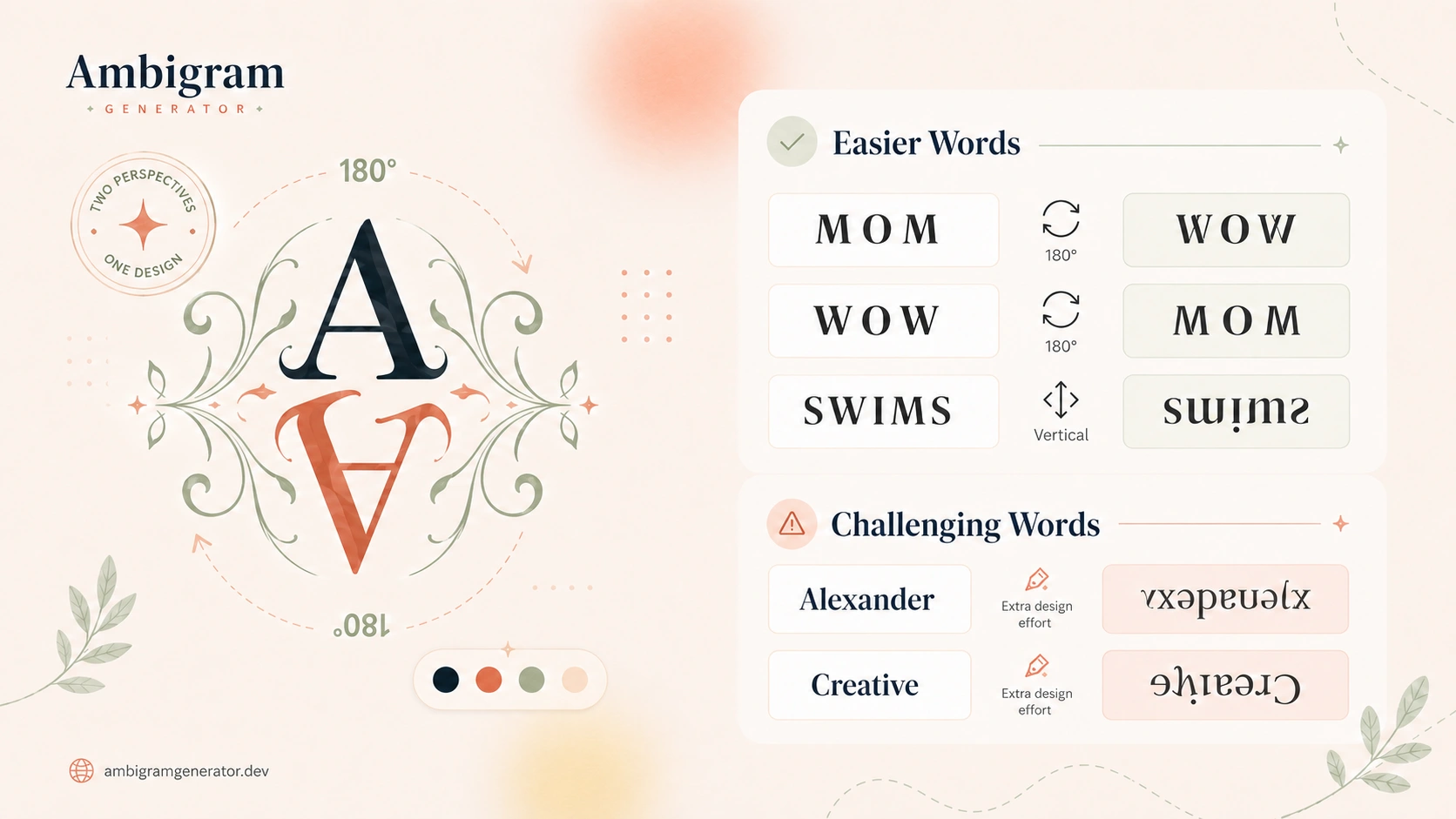
If you have ever spun a word around on paper just to see if it still reads the same way, you already understand the appeal of ambigrams. They feel like a small piece of magic hidden inside language. Naturally, the first question almost everyone asks is simple: can any word actually become an ambigram, or do only a lucky few qualify?
The honest answer is that most words can be turned into some form of ambigram, but not every word turns into a clean, effortless one. Some words practically design themselves. Others take real creative effort, clever letter substitutions, and a bit of trial and error. In this guide we will break down exactly why that happens and how you can work with almost any word, no matter where it falls on the difficulty scale.
What Actually Makes a Word Ambigram Friendly
An ambigram works because of visual symmetry, not meaning. A word becomes a strong candidate when its letters share balanced shapes that can mirror, rotate, or flip into something legible.
A few traits tend to matter most:
- Letter balance, meaning the word has a mix of rounded and straight letters that can visually echo each other
- Shorter length, since fewer letters mean fewer chances for awkward transitions
- Repeated or paired letters, which naturally support symmetry
- Consistent stroke weight, so the design does not feel lopsided when flipped
If you want the full breakdown of the concept itself, our page about ambigram covers the core idea in more depth before you start experimenting.
Words That Naturally Work as Ambigrams
Some words are almost built for this. These are often called natural ambigrams because they barely need any redesign to flip cleanly.
| Word | Symmetry Type | Why It Works |
| MOM | Rotational | Reads the same when turned 180 degrees |
| WOW | Rotational | Letters mirror each other around the center |
| NOON | Rotational | Palindrome structure supports the flip naturally |
| SWIMS | Rotational | A classic example used across ambigram communities |
| TENET | Bilateral | Reads the same forward and backward |
| CODE | Horizontal mirror | Symmetrical letterforms line up cleanly |
These words are a great starting point if you are new to ambigrams and want quick, satisfying results without heavy customization.
Can Difficult Words Still Become Ambigrams?
Yes, and this is really where the creativity comes in. Most names, longer words, and everyday phrases are not naturally symmetrical, but that does not rule them out. Skilled ambigram design leans on techniques such as:
- Substituting one letter shape for another that looks similar upside down
- Stretching or compressing certain strokes so two different letters can share a form
- Mixing uppercase and lowercase styles within a single word
- Adjusting spacing so the whole word balances even if individual letters do not
A good step by step guide can walk you through
Tips for Turning Almost Any Word Into an Ambigram
If your word is not on the easy list, try these approaches before giving up on it:
- Shorten it if possible, using a nickname, initial, or partial word
- Test more than one design style, since some fonts handle symmetry better than others
- Compare a rotational flip and a mirror flip, because a word that fails one may work with the other
- Break longer words or names into two lines so each line only has to balance with itself
- Be patient with revisions, since most successful ambigrams go through several drafts
An online tool makes this process far less tedious because you can preview multiple versions of your word in seconds instead of sketching each option by hand.
Single Words vs Two Word Phrases
Single words are usually the easiest place to start, but ambigrams are not limited to one word. Many people design pieces where one word transforms into an entirely different word or phrase when flipped, which opens up options for meaningful pairings like a name and a date, or two connected ideas.There are tools built specifically for testing how separate words interact
Where Ambigrams Show Up Most
Ambigrams are not just a novelty. They show up across several practical uses:
- Tattoos, where symmetry and symbolism combine into something personal and lasting
- Logos and branding, where a word that reads well from multiple angles feels distinctive
- Gifts and personal art, such as names, anniversaries, or meaningful short phrases
- Puzzle and design communities, where creators experiment purely for the visual challenge
previewing styles suited specifically to skin, placement browsing existing tattoo concepts
Quick Comparison: Easy vs Challenging Words
| Factor | Easier Words | Challenging Words |
| Length | Short, often 3 to 6 letters | Long names or full phrases |
| Letter shapes | Balanced curves and symmetrical forms | Irregular or inconsistent strokes |
| Structure | Palindromes or repeated letters | Unique, non repeating letters |
| Design effort | Minimal adjustment needed | Requires substitution and creative styling |
Frequently Asked Questions
Can any word technically become an ambigram?
In most cases yes, though the result will vary. Some words need almost no adjustment, while others require creative letter substitution to look clean.
Do names work well as ambigrams?
Names can absolutely work, though results depend on the letters involved. Shorter names or nicknames tend to produce cleaner designs than long full names.
What is the easiest type of word to start with?
Palindromes and words with repeated, symmetrical letters, such as MOM, NOON, or WOW, are usually the simplest place to begin.
Do I need design experience to make one?
No. With the right tool, you can test multiple versions of a word quickly and compare which style looks best without any drawing skills.
Is a mirror ambigram different from a rotational ambigram?
Yes. A mirror ambigram reads correctly when reflected, while a rotational ambigram reads correctly when turned 180 degrees. Some words work better with one method than the other.
Final Thoughts
So, can any word be an ambigram? In practice, almost every word has some ambigram potential, but the amount of effort needed depends heavily on its letters, length, and structure. Simple, symmetrical words tend to work right away, while longer or irregular words usually need a bit of creative styling to look right.
The easiest way to find out where your word falls is simply to test it. Tools like the ambigram generator let you type in a word, preview different styles instantly, and compare results side by side, so you can see for yourself whether your name, word, or phrase is ready to become an ambigram or just needs a small creative push to get there.