The History and Development of Ambigram Art
Look at a word written normally, then turn it upside down or catch it in a mirror, and if it still spells something recognisable, you’re looking at an ambigram art. It feels like a magic trick done with letters instead of cards, and once you notice how these designs work, it’s hard to stop spotting the pattern in logos, tattoos, book covers, and even wedding invitations. The letters seem to know two things at once, and that small bit of visual trickery is enough to make people stop scrolling and look twice.
Ambigram art looks like it should be centuries old, the kind of thing carved into old manuscripts or hidden inside royal seals waiting to be decoded. In reality, ambigrams as we know them today are a fairly recent invention, shaped mostly over the last fifty years by a small group of designers who were chasing the same idea from different directions at almost the same time, without knowing about each other’s work at first. What feels timeless is actually the product of a handful of very specific people and a very specific decade.
What started as a clever design puzzle slowly grew into a full art form with its own vocabulary, its own techniques, and eventually its own place in pop culture, tattoo studios, and now design software. This post walks through how ambigram art came to be, who shaped it along the way, what pushed it into the mainstream, and how it ended up as something anyone can create online today without needing a background in calligraphy or typography.
Start
Designing
in Seconds
Create stylish ambigram designs for names, tattoos, words and logo ideas.

Where Ambigram Art Began
Early Symmetrical Wordplay
Before the word “ambigram” existed, people were already playing with symmetrical lettering under different names, usually as a side hobby rather than a serious art practice. In the 1960s, wordplay writer Dmitri Borgmann described similar designs as vertical palindromes, treating them more like a linguistic puzzle than a visual one. Around the same period, French writer Georges Perec, known for his love of constrained writing, called his own versions design natures and used them as part of his broader fascination with wordplay and structure. These early experiments weren’t tied to one artist or one style. They were scattered attempts by puzzle lovers, writers, and typographers who noticed, almost by accident, that letters could be bent, mirrored, or turned without losing their meaning, long before anyone thought to give the idea a proper name.
The Pioneers Who Named It
Two designers are usually credited with turning this scattered idea into a real, recognised art form. Scott Kim, working largely on his own, called his creations inversions and published a full book on them in 1981, laying out methods and examples that treated ambigram design almost like a solvable puzzle. Around the same time, Philadelphia based designer John Langdon was building what he simply called upside down words, and had already sold his very first piece, the word STARSHIP, to a rock band all the way back in 1976, years before the field had any shared terminology at all. It was cognitive scientist Douglas Hofstadter, better known for his writing on consciousness and self reference, who eventually gave the art form its lasting name, coining the term ambigram in the early 1980s and helping tie these separate threads of work together under one word.
Try Your Tattoo Word
Milestones That Shaped Ambigram Art
- Scott Kim publishes Inversions in 1981, the first book built entirely around the art form
- John Langdon sells his STARSHIP ambigram to a rock band years before the term even existed
- Douglas Hofstadter coins the word ambigram in the early 1980s
- John Langdon publishes Wordplay in 1992, bringing wider attention to the craft
- Dan Brown’s novel Angels and Demons in 2000 features Langdon’s Illuminati ambigrams
- Tattoo studios start offering ambigram designs as a popular custom request through the 2000s
- Online tools later let anyone design an ambigram without any design training at all


Why Ambigram Art Still Matters Today
For most of its history, ambigram design stayed in the hands of a few trained calligraphers and designers who could spend hours balancing every curve, stroke, and angle by eye until the two readings finally lined up. It was slow, exacting work, closer to solving a puzzle than sketching a doodle, and that difficulty is part of why the field stayed so small for so long. That changed once design software, and later online generators, took over the technical heavy lifting, letting anyone type a name or word and see it turned into a working ambigram in seconds instead of hours.
That shift didn’t make the art form any less interesting, it just opened the door wider. People now use ambigrams for tattoos, wedding gifts, band logos, birthday presents, and personal projects that mean something specific to them, without needing years of lettering practice or a design degree first. The core idea Hofstadter, Kim, and Langdon were each chasing decades ago, a word quietly hiding another word inside its own shape, is still exactly what makes people stop and look twice today, whether they’re reading a novel, scrolling online, or looking down at their own arm.
Frequently Asked Questions
The quick answers most people are looking for.
What is an ambigram?
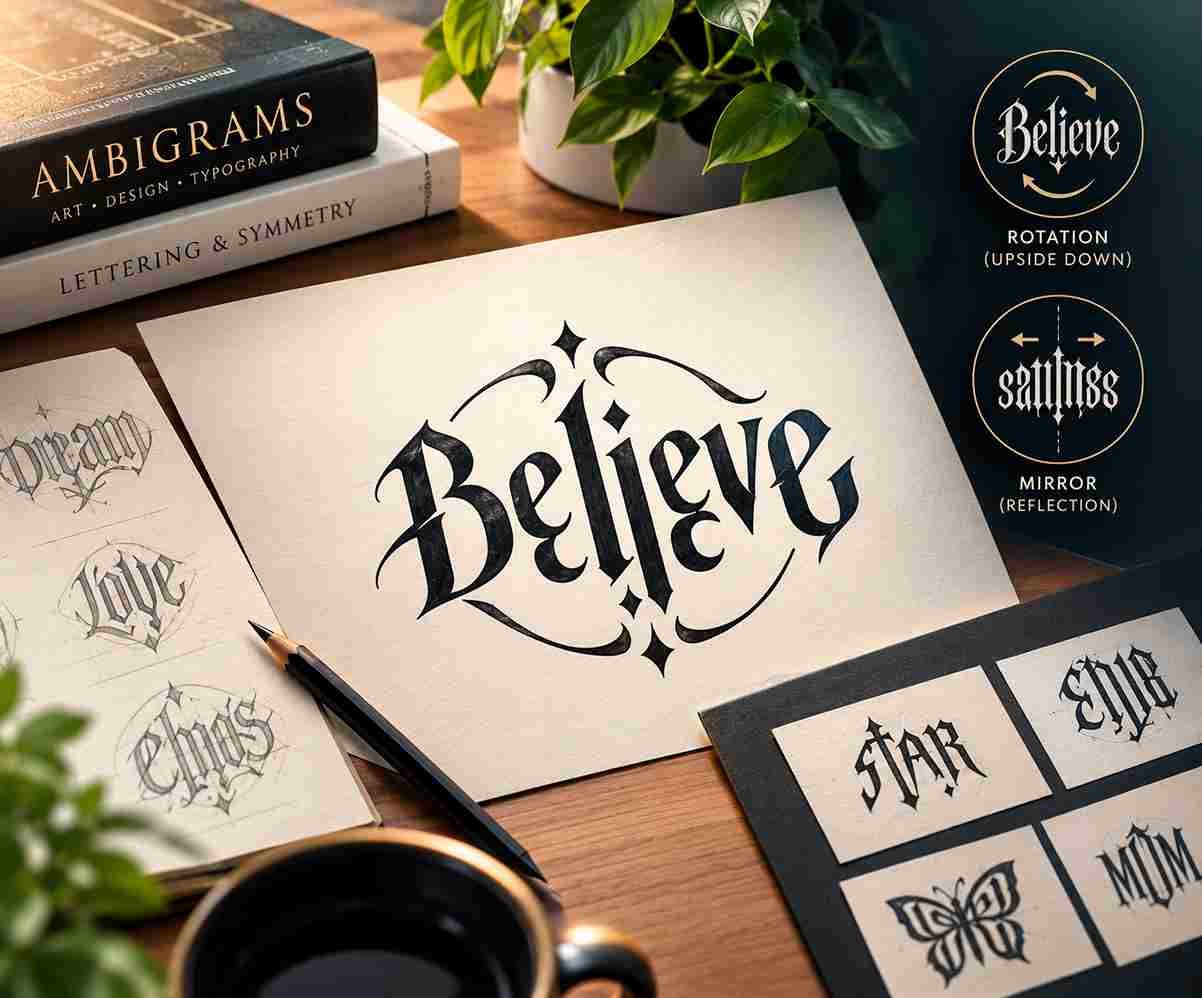
An ambigram is a word or phrase designed so it can still be read after being flipped, rotated, or mirrored. Some spell the same word both ways, while others are built so the flipped version reveals a completely different word or phrase, which usually takes a bit more skill to pull off cleanly.
Who invented ambigrams?
No single person invented them, and that’s part of why the history feels a little tangled. Scott Kim and John Langdon both created early examples on their own in the 1970s without knowing about each other’s work, and Douglas Hofstadter later gave the art form its shared name and helped bring the different threads together.
How is an ambigram different from a palindrome?
A palindrome reads the same forwards and backwards as plain text, like the word radar or the phrase level. An ambigram depends on the shape of the letters rather than their order, so it works visually and often only makes sense once you actually see it, not just when you read the letters out loud.
Why did ambigrams become popular as tattoos?
Their symmetry and hidden meaning made them a natural fit for body art, since a single design can carry a name, a word, or a private meaning that only reveals itself fully when someone looks closely. Interest grew even further after they appeared in Dan Brown’s Angels and Demons, which introduced the idea to readers who had never seen anything like it before.
What are the main types of ambigrams?
Common types include rotational ambigrams that read the same when turned upside down, mirror ambigrams that work when reflected, and chain ambigrams where the same word repeats in a continuous loop, one version flowing directly into the next. Some designers also experiment with figure ground ambigrams, where the background and the letters trade places.
Can anyone design their own ambigram now?
Yes, and that’s probably the biggest change in the art form’s short history. What once took years of hand lettering practice can now be done with online generators, letting anyone experiment with their own name, a partner’s name, or a word that carries some personal meaning, all without touching a pen or brush.