What Do You Call a Word You Can Read Upside Down?
When you don’t know what do you call a word you can read upside down? Try this: write your name on a piece of paper, then flip it around. Odds are it turns into gibberish, just a random smear of loops and lines that no longer means anything. But every so often you’ll spot a logo, a tattoo, or even a random street sign that does something strange. Turn it 180 degrees and it still says the same word, clean and readable, like nothing happened at all. That little moment of “wait, how did they do that” is more common than most people realize, and once you notice it once, you start catching it everywhere.
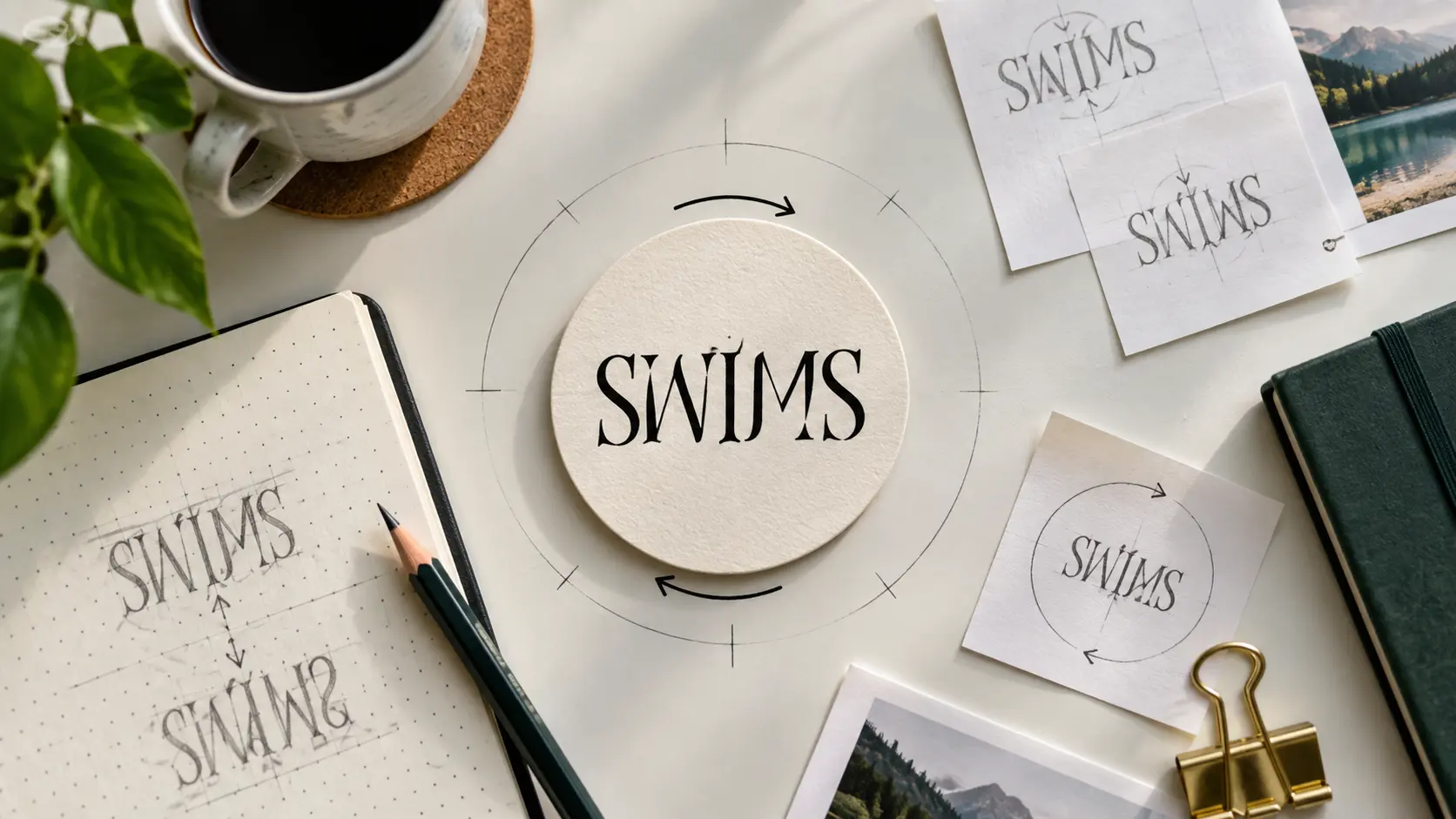
The word you’re looking for is ambigram. An ambigram is a piece of text, usually a single word or short phrase, that has been drawn or arranged so it can be read in more than one orientation. Flip it, mirror it, rotate it, and the letters still form something meaningful, often the exact same word you started with, sometimes a completely different one. It’s part typography and part optical illusion, which is why it tends to fascinate people even after they know how the trick is done.
It sounds like a small novelty, but designers, tattoo artists, and word puzzle fans have been playing with the idea for decades, and it’s not just a modern internet trend either. Some words fall into this shape almost by accident because of how their letters happen to be built, needing barely any adjustment. Others need a skilled hand, or these days a bit of software, to bend the letterforms into place until the second reading clicks. Either way, once you learn the term and start looking for it, you’ll spot ambigrams on band merch, wedding invitations, gym logos, and plenty of the tattoos you walk past without giving a second thought.
Start
Designing
in Seconds
Create stylish ambigram designs for names, tattoos, words and logo ideas.

The Name Behind the Trick
Where the Word Ambigram Comes From
The word itself is built from Latin roots, with “ambi” meaning both and “gram” referring to something written or drawn, so the literal sense is close to “written both ways.” The visual idea existed informally long before the name did, showing up in old typographic experiments and playful signage, but it really picked up momentum in the 1970s and 80s when artists like Scott Kim and John Langdon started publishing collections of these designs and demonstrating just how far the concept could be pushed with careful letterwork. The term found a much wider audience later on when Dan Brown used ambigrams as a central plot device in Angels & Demons, with designer John Langdon creating the actual artwork for the book. Suddenly a lot of readers were googling the word for the first time and realizing this thing they’d been half noticing their whole lives actually had a name.
What Makes a Word Work This Way
Not every word cooperates equally, and this is really where the craft of ambigram design lives. Letters like N, S, Z, H, I, O, and X are naturally friendlier to this kind of transformation because their basic shapes hold up reasonably well when flipped or rotated, sometimes needing only minor tweaks. Letters like Q, G, or R tend to cause more trouble and force a designer to get creative, reshaping curves and stems until they can pull double duty. Some words happen to work with almost no adjustment at all, which people call natural ambigrams, and finding these is honestly half the fun for anyone who enjoys this kind of wordplay. Others need the letters stretched, curved, blended into their neighbors, or given extra flourishes so the shape reads correctly from both directions without looking forced. This is really the whole challenge behind it, finding or engineering a balance where the eye can be convinced twice using the exact same set of lines.
Try Your Tattoo Word
Common Types of Ambigrams
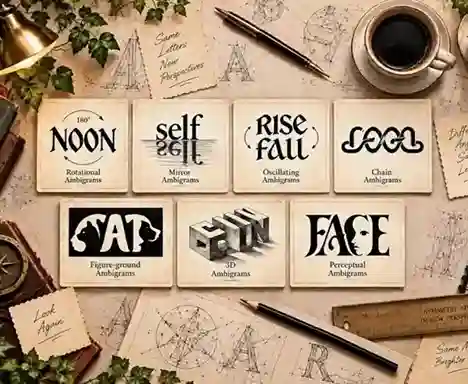
- Rotational ambigrams read the same word after being turned a full 180 degrees
- Mirror ambigrams reflect across a line, like looking in a mirror or still water
- Oscillating ambigrams flip into a second, different word instead of repeating the first
- Chain ambigrams string letters together so one shape flows directly into the next
- Figure ground ambigrams hide a second word in the negative space around the letters
- 3D ambigrams only reveal their second reading when viewed from one specific angle
- Perceptual ambigrams lean on clever font styling rather than true letter symmetry
Almost any word can be adapted with enough design effort, though some words cooperate far more easily than others. Words built from naturally symmetrical letters tend to need very little reshaping, while others require a lot more artistic stretching, spacing, and creative compromise to make both readings actually work without one side looking awkward. Figure ground ambigrams hide a second word in the negative space around the letters

Where These Designs Show Up in Real Life
Tattoos are probably where most people first run into ambigrams, and for good reason. A name that reads the same right side up and upside down means it looks correct to the wearer glancing down at their own forearm and equally correct to anyone standing across from them, which is a pretty neat piece of engineering for something permanent. Family names, kids’ names, wedding dates, and short meaningful phrases are popular choices for this exact reason, since the personal weight of the word pairs naturally with the cleverness of the design. Memorial tattoos in particular lean on this style a lot, letting someone carry a name in a way that feels intentional rather than just decorative.
Logos borrow the same underlying trick for slightly different reasons, using the flip or rotation to hint at duality, balance, or some hidden second meaning tied to the brand’s story. Making one of these by hand takes real skill and patience, since every single letter has to be reshaped until it can convincingly play two roles at once without one reading suffering to prop up the other. That’s part of why so many people now turn to an ambigram generator instead of sketching it out themselves, typing in a name or word and letting the software work out the rotation, spacing, and overall style in seconds rather than hours. It’s a much faster way to test whether a particular word or name even has the raw potential to become a strong ambigram before committing to ink, a logo file, or anything harder to undo, and browsing through a few different styles on a site built for exactly this purpose can save a lot of guesswork compared to trying to eyeball it on paper first.
Frequently Asked Questions
The quick answers most people are looking for.
Is an ambigram the same thing as a palindrome?
No, and this mix up is pretty common. A palindrome reads the same forward and backward as a sequence of letters, like “level” or “racecar,” and it has nothing to do with how the word looks visually. An ambigram is entirely about visual orientation, meaning the same word or phrase stays readable when the actual image is flipped, rotated, or mirrored, regardless of whether the letter order itself is symmetrical.
Can any word be turned into an ambigram?
Almost any word can be adapted with enough design effort, though some words cooperate far more easily than others. Words built from naturally symmetrical letters tend to need very little reshaping, while others require a lot more artistic stretching, spacing, and creative compromise to make both readings actually work without one side looking awkward.
Who came up with the term ambigram?
The word is generally credited to Scott Kim’s work and writing in the 1970s, though similar visual wordplay existed informally under different names well before that. Douglas Hofstadter also helped popularize the concept in his writing around the same era, which brought it to an even wider audience of readers interested in puzzles and perception.
Do I need design experience to make one?
Not anymore, which is honestly one of the bigger shifts in the last few years. Hand drawn ambigrams do take real practice and a good eye for letterforms, but online tools can now generate a workable version from typed text almost instantly, which makes the whole idea accessible even if you’ve never done any lettering or calligraphy work before.
Are ambigrams only used for names?
Names are the most common choice by far, especially for tattoos, but short words, dates, single letters, and meaningful phrases all work just as well. Businesses often use them for logos, and some people even create them as gifts, choosing a word that matters to the recipient rather than a name.
What's the easiest type of ambigram to start with?
Rotational ambigrams are usually the most approachable starting point since they only require the word to read correctly after a single 180 degree turn, rather than juggling mirror reflections or trying to hide a second, entirely different word inside the same shape.