What Is a Symbiotogram Ambigram?
A symbiotogram ambigram is one of those terms that sounds far more technical than it actually is. Spend enough time looking at ambigram designs and you’ll run into it eventually, tucked in next to rotational, mirror, and chain. Once you see one in action, it clicks almost immediately, and after that you can’t stop flipping random words in your head to see if they’ve got a hidden twin.
A symbiotogram is one of the more fun corners of ambigram design, mostly because it’s not really about one word at all. It’s about two words agreeing to share the same handful of strokes. Here’s what that means in practice, how it’s different from the ambigrams you’ve probably already come across, and why some words simply refuse to cooperate.
Start
Designing
in Seconds
Create stylish ambigram designs for names, tattoos, words and logo ideas.

How It's Different From a "Regular" Ambigram
Most people’s mental picture of an ambigram is a single word that survives the flip of your name upside down and still reads as your name. That’s a rotational ambigram, and it’s what most tattoo studios and online generators are set up to produce.
Same Word, Both Ways
This is the version everyone’s seen before. You write “Faith,” rotate it 180 degrees, and it still says “Faith.” The letterforms get reshaped just enough to hold their meaning through the flip, which is part of why it feels like a small bit of magic tied to one word that matters to you.
Two Words, One Shape
A symbiotogram takes that same rotation and does the opposite thing with it. Instead of preserving one word’s identity, it uses the flip to introduce a second word that has nothing to do with the first, at least not on paper. Every stroke has to satisfy two separate readings, which honestly makes it a much harder puzzle to solve than styling a font around a single word.
A few things tend to separate the two approaches:
- A standard ambigram needs one word to work with. A symbiotogram needs a matched pair, which is the hard part.
- One style protects meaning through the rotation; the other creates new meaning out of it.
- Finding a solid symbiotogram pair feels a lot closer to solving a word puzzle than picking a font.
- Symbiotograms tend to lean into contrast opposites, transformations, before-and-after ideas because that’s where the format actually shines.
Try Your Tattoo Word
Where the Name Comes From
“Symbiotogram” borrows from symbiosis two different organisms living together, each one depending on the other to survive. Swap “organisms” for “words” and that’s more or less the definition.
The “gram” part is the same ending you’ll find in “ambigram” itself, tracing back to a Greek root for something written or drawn.
A Few Real Examples
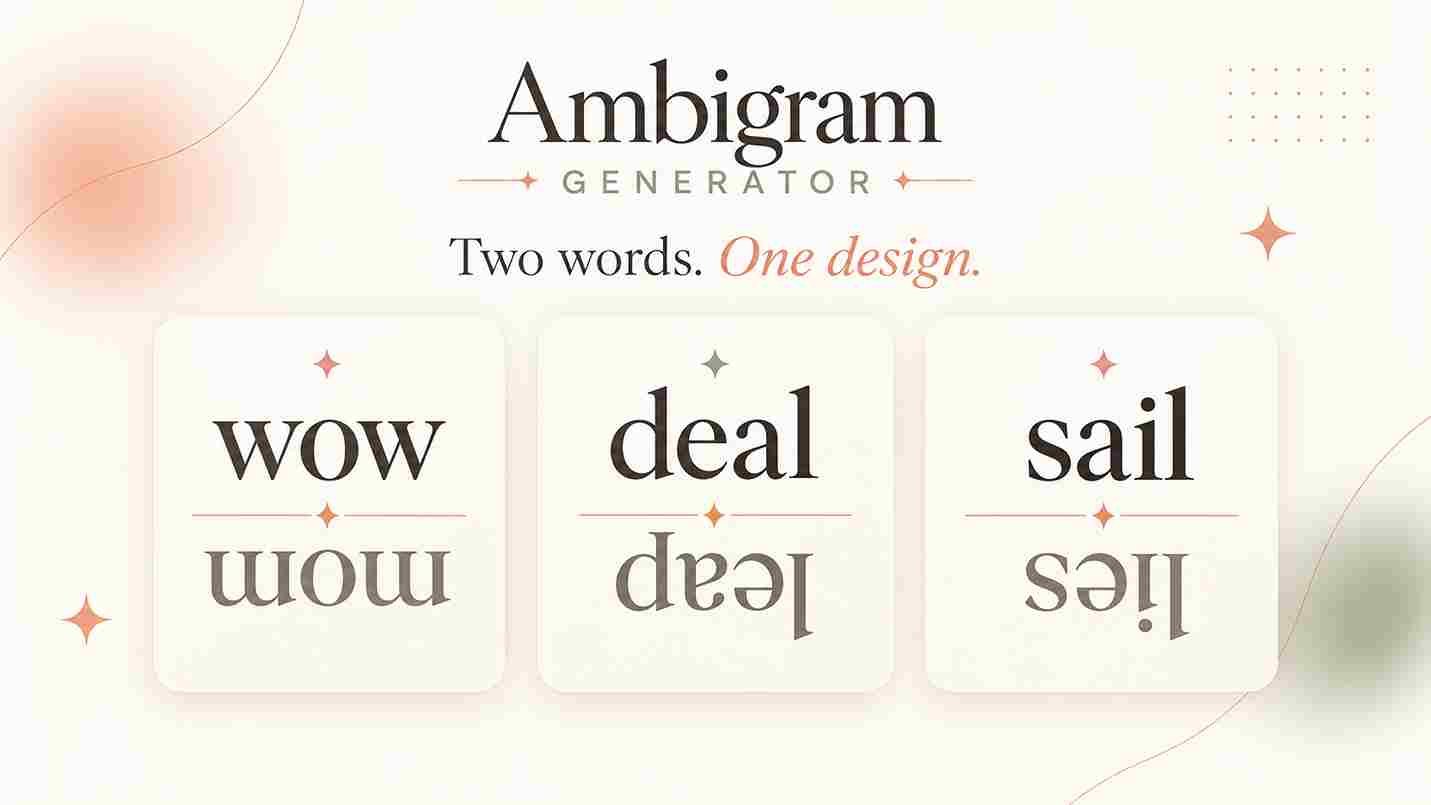
Seeing actual word pairs side by side makes the idea click a lot faster than any explanation does. These are commonly used symbiotogram examples that hold up cleanly when rotated 180 degrees:
Upright | Rotated 180° | Why it works |
wow | mom | Short, symmetrical letters like w and o carry most of the weight |
sled | pals | Straight strokes reorganize neatly into new letterforms |
deal | leap | Matching letter count keeps the proportions balanced |
sail | lies | Curved letters rotate into other curved letters without much fuss |
dooms | swoop | Longer pairs still work when the letter rhythm lines up |


What Makes a Word a Good Candidate
Not every word has a partner sitting somewhere out there waiting to be discovered, and honestly, that’s the hardest part of the whole process. The real design work only starts once you’ve found a pair willing to cooperate.
- Letters with rotational symmetry, like o, s, x, z, n, and h, are far easier to reshape without losing legibility.
- Similar word length keeps the spacing from feeling stretched on one side and cramped on the other.
- Simple, blocky letterforms leave more room to bend a stroke into double duty than delicate, decorative ones do.
- Fewer tall or dangling letters (b, g, j, p, and the like) make the final flip easier to balance visually.
Where People Actually Use Symbiotogram Ambigrams
- Tattoos built around opposites strength and weakness, chaos and calm, that sort of pairing
- Wedding or couple designs where two names, or two ideas, sit inside one shape
- Logos for brands built around a “two sides of the same coin” concept
- Personal gifts where the second word is meant to be a surprise once someone flips it
- Straightforward wordplay projects, just for the fun of the puzzle itself
Frequently Asked Questions
The quick answers most people are looking for.
Is a symbiotogram the same thing as an ambigram?
Not a separate category subtype. Ambigram is the umbrella term for any design that reads differently depending on orientation. Symbiotogram just describes the specific version where two different words share one rotated shape.
Does every word have a symbiotogram match somewhere?
No, and most don’t. Finding one usually takes deliberate searching through word lists or just testing candidates by hand and seeing what the rotation actually spits out.
Can a generator make a symbiotogram for me?
It can help you test how a word rotates and rule out pairs that obviously won’t work, which saves a lot of trial and error. Getting both words to read cleanly usually still takes some manual fine-tuning after that.
Does it have to be rotation, or can a symbiotogram be mirrored instead?
Rotation is by far the most common approach, and it’s what almost every known example uses. Mirror versions exist in theory, but they’re rare, since lining up two different words across a mirror axis is a lot harder than lining them up across a 180-degree turn.
What's a good first symbiotogram to try designing?
Stick to something short three or four letters, ideally with a rounded or symmetrical character or two. “Wow” and “mom” gets used as the teaching example for a reason: it’s short enough to sketch out by hand in a handful of tries.