What is ambigram tattoo
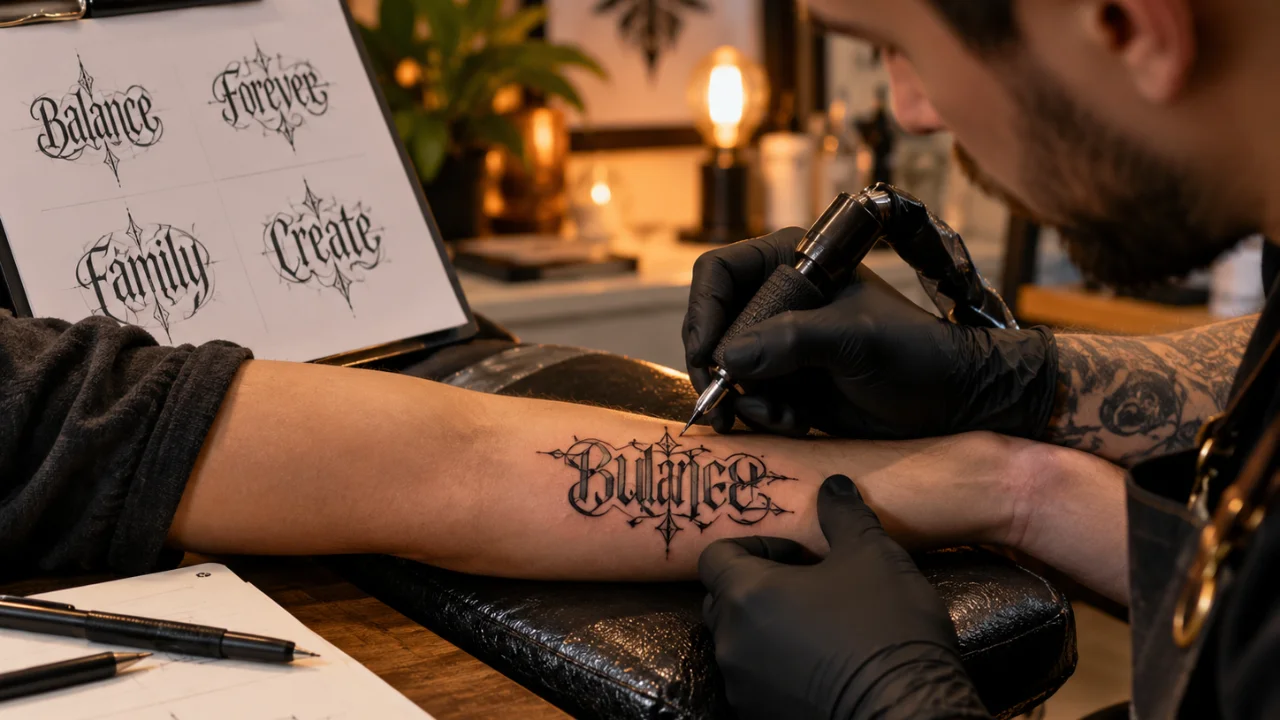
An ambigram tattoo is lettering that can be read from more than one direction, usually upside down or in a mirror. When it works, it looks clever. When it doesn’t, the mistake is permanent.
This guide helps you avoid that. You will learn the common types, how to pick a word that flips well, a six-step check to run before you book, and how to brief a tattoo artist. It is a planning guide, not a replacement for a professional.
Quick note: Treat any online preview as a concept, not a final design. Have a licensed tattoo artist finalize the artwork, check every reading for unintended words, and never copy another artist’s ambigram. This guide is general information, not medical or aftercare advice. Ask your tattooist and a health care professional about healing or skin reactions.
Start
Designing
in Seconds
Create stylish ambigram designs for names, tattoos, words and logo ideas.
Ambigram Tattoo: How to Design One That Reads Right Both Ways
An ambigram tattoo is a piece of lettering designed to be read in more than one orientation, most often when turned upside down or viewed in a mirror. The design can spell the same word both ways or reveal a different word when flipped, which is why it suits names and meaningful words.
The word ambigram was introduced by cognitive scientist Douglas Hofstadter in the 1980s, according to Merriam-Webster. The same entry notes that designers often use calligraphic ambigrams for logos and tattoos.
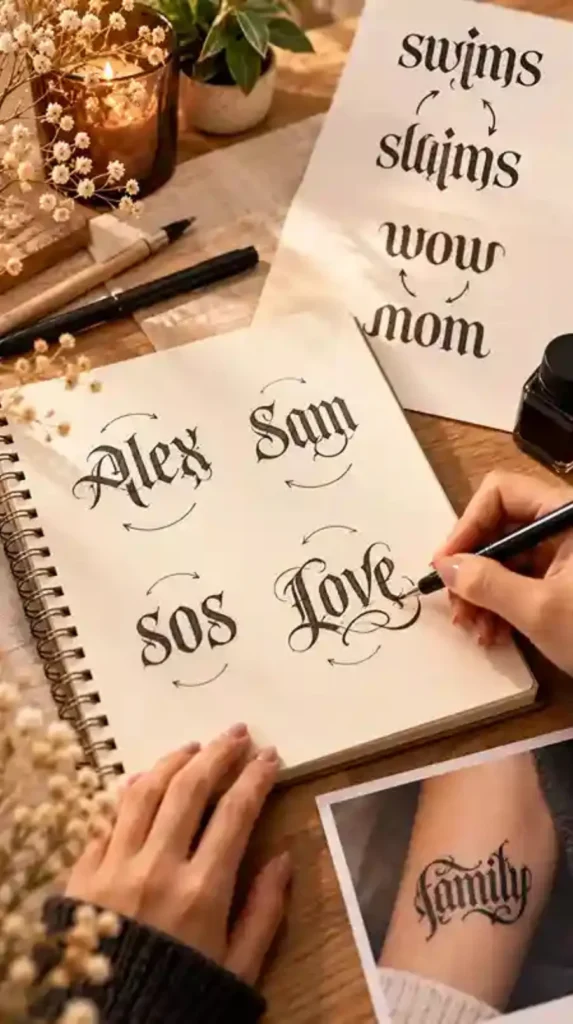
The dictionary’s examples show the idea. Turn swims upside down and it still reads swims. Turn wow upside down and it reads mom.
Some ambigrams are natural, meaning the plain letters already flip. Most tattoo ambigrams are designed. An artist reshapes the letters by hand or with software so the word works both ways. For more background, see what an ambigram is.
Try Your Tattoo Word
Which Words and Names Work Best?
Short words and names with balanced, flexible letters usually work best for an ambigram tattoo. Shorter words leave fewer letters to reshape, and in many typefaces letters such as s, o, x, and z look the same upside down. Test several words before choosing, because some resist flipping.
Use this quick scorecard before you fall in love with a word:
- Length: Shorter is safer. A four-letter name leaves fewer letters to reshape than a full sentence.
- Friendly letters: In many typefaces, the letters s, o, x, and z look the same upside down. In lowercase, n and u, d and p, and b and q trade places when turned.
- Tricky letters: Letters like f, r, t, and k often need more bending to work.
- Style: Bold styles, such as blackletter (a heavy, old-style script), tend to hide awkward joins better than thin, plain lettering.
Here is how the scorecard works on real words. In swims, the s and i look the same upside down, and w and m trade places, so the word reads the same either way. In wow, the w turns into an m and the o stays put, so the same shapes give a different word, mom.
A two-word design is harder. Every letter in one word must also pass for a letter in the other, so similar lengths and similar letter shapes help. You can test a pair with the two-word ambigram generator. For more word ideas, browse these ambigram examples.
If your word is in a language you don’t read, ask a fluent speaker to check the spelling and meaning before it goes on your skin
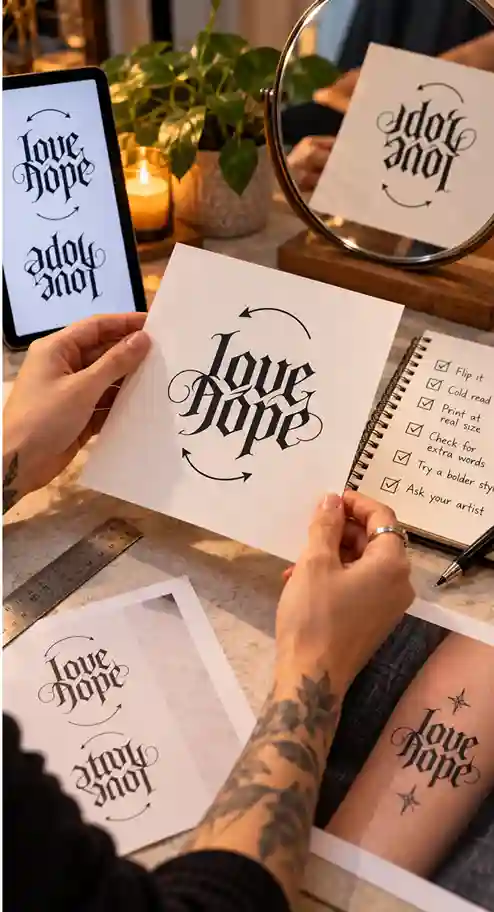
How to Check an Ambigram Tattoo Before You Get Inked
To check an ambigram tattoo before inking, test how clearly it reads in every orientation. Flip it, ask three people to read it cold, print it at real size, and look for unintended words in each direction. If any reading is unclear, change the word or style before booking the appointment.
Legibility just means how easily a reader can decode the letters. Run these six checks in order:
- Flip it. Rotate the design 180 degrees, or hold it to a mirror if it is a mirror design. Both readings should be clear within a second or two.
- Run a cold read. Show the design to three people who don’t know the word. Ask what each reading says. If they hesitate or disagree, the design hides too much.
- Print it at real size. Print the design at the size you want on your body and view it at arm’s length. Thin lines and tight joins can blur together when small.
- Hunt for extra words. Look at the design flipped, mirrored, and with parts covered. Make sure no unwanted word appears. Flipping changes meaning, as wow turning into mom shows.
- Try a bolder style. If a join looks awkward, test a heavier style and compare.
- Ask your artist. Ask whether the lines will hold at your chosen size and whether they would change any letter.
Take your time, because the result lasts. The U.S. Food and Drug Administration says permanent tattoos are designed to last a lifetime and are difficult to remove. It adds that some removal procedures may leave permanent scarring or fail to remove the tattoo completely (FDA: Think Before You Ink).
Types of Ambigram Tattoos and Which One Fits
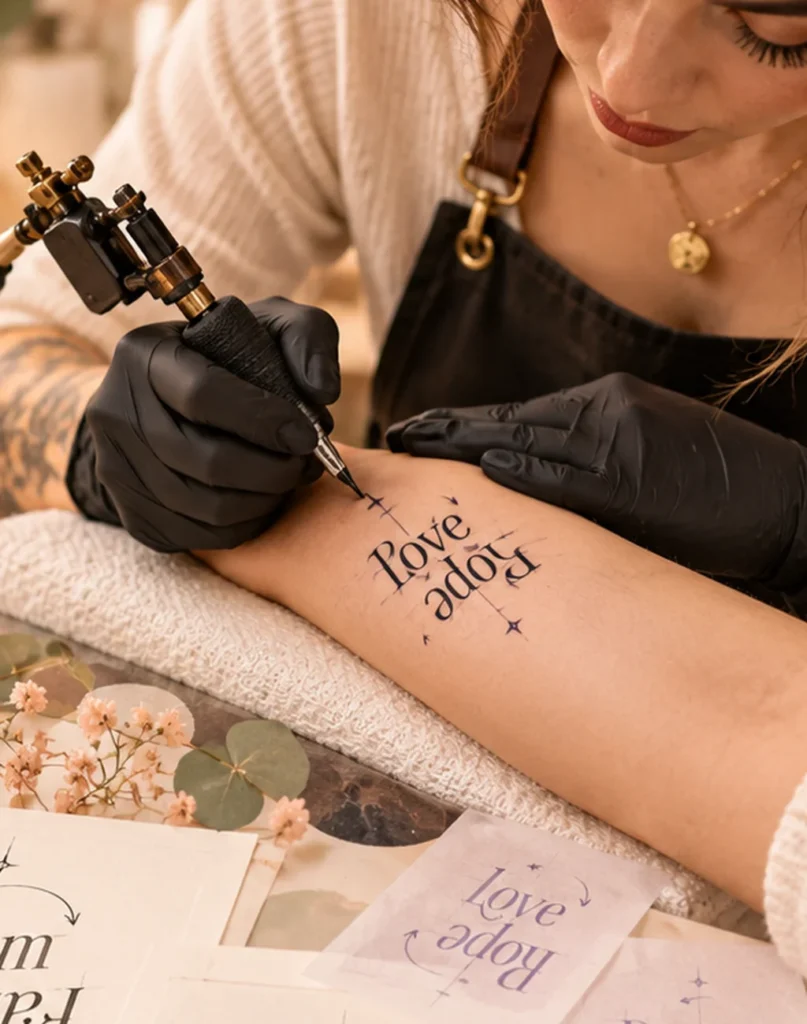
Common types of ambigram tattoos include rotational, mirror, two-word, and perceptual-shift designs, though terminology varies by source. A rotational design reads when turned 180 degrees, a mirror design reads in reflection, a two-word design shows a different word each way, and a perceptual-shift design changes with how you interpret its curves.
Pick the type first, because it decides which words and placements will work.
| Type | How it reads | Placement logic | Check before inking |
|---|---|---|---|
| Rotational ambigram | Same word or a new word when turned upside down | Decide which reading people should see upright, then place it to match | Letters that need heavy reshaping to flip |
| Mirror ambigram tattoo | Same or a new word when reflected | Think about the reflection axis and ask your artist how it will sit on your body | The design may read backward without a mirror |
| Two-word | One word one way, a second word when flipped | Both words must matter to you, so pick which one is primary | Pairs with different letter counts are harder to balance |
| Perceptual shift | Two readings from one shape, depending on how you interpret the curves | Less tied to flipping, so test it from your normal viewing angle | Needs skilled lettering, so ask to see past work |
Ambigram Generator or Custom Artist?
An ambigram generator is best for testing ideas quickly, while a custom artist is best for a final, hand-tuned design. A generator lets you compare words and styles in seconds. An artist can reshape individual letters, balance the spacing, and adapt the design to your body, which matters when the result is permanent.
Whichever route you choose, the final ambigram tattoo design should be approved by your artist.
Use a generator to answer one question: does my word have a chance? Use the tattoo ambigram generator on Ambigram Generator to preview your word in different styles before you decide.
Treat the result as a concept. Previews can have rough joins that a skilled lettering artist would redraw. If you like to draw, you can also try how to make an ambigram by hand to see how letters get reshaped.
How to Brief a Tattoo Artist on an Ambigram
A clear brief saves time and protects the design. Bring this to your consultation:
- Word or words: the exact spelling and any capitalization you prefer.
- Symmetry type: rotational, mirror, or two-word.
- Main reading: which version people should see first.
- Placement: the body area, and how that body part is usually held.
- Size: the real size you want, in centimeters or inches.
- Style: bold, script, blackletter, or another look, plus reference images.
- Must-keep letters: any letters or shapes that matter most to you.
- Your test results: the cold-read feedback and your printed preview.
Ask to see the stencil before any ink goes in. A stencil is the printed outline placed on your skin. Check both readings from different angles, then approve it or ask for changes.
Choose a studio that follows your local health and hygiene rules. The FDA notes that, in the United States, state and local authorities oversee the practice of tattooing. It also says infections can come from unhygienic practices, non-sterile equipment, or contaminated ink. Rules vary by country, so check your local health authority. If a new tattoo isn’t healing or a rash appears, the FDA advises contacting your tattooist and a health care professional.
Where to Place an Ambigram Tattoo So It Reads Correctly
An ambigram tattoo reads best when its placement matches the way people will actually view it. For a rotational design, decide which reading should appear upright to onlookers, then ask your artist to test the stencil from several angles. Mirror and two-word designs need the same viewing test before inking.
A rotational ambigram tattoo has two readings, so there is no single “right way up.” That choice is yours. Ask yourself three questions:
- Who will see it most often, you or other people?
- Which reading matters more?
- Will the body part move into other positions?
Placing the stencil and looking at it from each side is the fastest way to find the answer.
What Your Ambigram Tattoo Can Say
Most ambigram tattoos follow one of three patterns:
- Same word both ways: one meaningful word that reads the same upright and flipped.
- Opposite pairs: two contrasting words in one design.
- Reinforcing pairs: two words that support each other.
Names are a popular choice for ambigram tattoos because they are short and personal, and an ambigram name tattoo needs the same checks as any other word. Whether you want a name, a symbolic word, or an upside-down word tattoo with two meanings, the same checks apply. For more inspiration, see these ambigram tattoo ideas.
Test Your Word Before You Book
Ready to try your word? Open the tattoo ambigram generator on Ambigram Generator, compare a few styles, and bring your best preview to your artist. That is the simplest way to get an ambigram tattoo that reads right both ways.
Frequently Asked Questions
The quick answers most people are looking for.
What is an ambigram tattoo and how does it work?
An ambigram tattoo is lettering drawn so it reads as a word from more than one angle. Each letter is reshaped to double as another letter when the design is rotated 180 degrees or reflected, producing the same word or a different one.
Can any word or name become an ambigram tattoo?
Not every word works well. Long or awkward words can need so much reshaping that they become hard to read. Test a short version, try a bolder style, and ask three people to read it cold. If they hesitate, choose another word.
Should I use an ambigram generator or hire an artist?
Both, in sequence. Test words and styles in a generator first. Then print your best preview at real size, show it to a tattoo artist for a redraw, and approve the stencil from every angle before any ink goes in.
Where should I place an ambigram tattoo so it reads properly?
Choose the spot based on who will read it. Decide which reading should appear upright to onlookers, then have your artist place the stencil and view it from each side. Move it if either reading looks unclear.
Our Sources
- Merriam-Webster, “ambigram”: https://www.merriam-webster.com/dictionary/ambigram
- U.S. FDA, “Think Before You Ink: Tattoo Safety”: https://www.fda.gov/consumers/consumer-updates/think-you-ink-tattoo-safety